Latest Post

Latest POSTS

Universal Gates

NAND Gate:
 
             The NAND gate represents the complement of the AND operation. Its name is an abbreviation of NOT AND.

             The graphic symbol for the NAND gate consists of an AND symbol with a bubble on the output, denoting that a complement operation is performed on the output of the AND gate.

The truth table and the graphic symbol of NAND gate is shown in the figure.


The truth table clearly shows that the NAND operation is the complement of the AND.

NOR Gate:

           The NOR gate represents the complement of the OR operation. Its name is an abbreviation of NOT OR.
           The graphic symbol for the NOR gate consists of an OR symbol with a bubble on the output, denoting that a
complement operation is performed on the output of the OR gate.

           The truth table and the graphic symbol of NOR gate is shown in the figure.

  
The truth table clearly shows that the NOR operation is the complement of the OR.

To build a basic gates using universal gates:

Using NAND Gate:

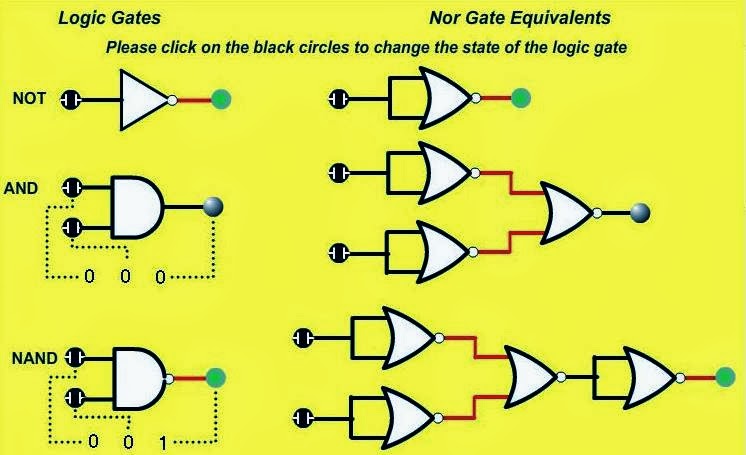
NAND Gate

Click the picture to see the flash Animation


Using NOR Gate:

NOR Gate
 
Click the picture to see the flash Animation
 

Logic Gates

Logic gates are the basic elements that make up a digital system. The electronic gate is a circuit that is able to operate on a number of binary inputs in order to perform a particular logical function. The types of gates available are the NOT, AND, OR, NAND, NOR, exclusive-OR, and the exclusive-NOR .

The gate is a digital circuit with one or more input voltages but only one output voltage. The operation of a logic gate can be easily understood with the help of Truth Table. A truth table is a table that shows all the input-output possibilities of a logic circuit.

Logical Operators:

There are three basic logical operators: NOT/INVERT, AND and OR.

Logic Gates:

 NOT Gate
AND Gate
OR Gate
NAND Gate
NOR Gate
Exclusive-OR Gate
Exclusive-NOR Gate

NOT Gate:


The inverter performs a basic logic function called inversion or complementation. The inverter changes one logic level to its opposite level. when a HIGH level is applied to an inverter input, a LOW level appear on its output. When LOW level is applied to it input, a HIGH level appear on its output.

  Symbol:                                                   Truth Table:


AND Gate:


The AND Gate may have two or more inputs and a single output .The opetaions of the AND gate is such that the output is HIGH only when all of the inputs are HIGH. When any of the inputs are LOW, the output is LOW. 

Symbol:                                                  Truth Table:


OR Gate:
 
The OR Gate has two or more inputs ans one output. The operations of the OR gate is to determine when one or more of its inputs are HIGH and to produce a HIGH on its output toindicate this condition.

Symbol:                                                 Truth Table:   


NAND Gate:
 
The term NAND is a contraction of NOT-AND and implies and AND function with a complemented (inverted) output. The NAND gate is a universal gate as it can be used to construct an AND gate, an OR gate an inverter or any combination of these functions. The logical operation of the NAND gate is such that a LOW output occurs only when all inputs are HIGH. When any of the inputs is LOW, the output will be HIGH.

Symbol:                                                 Truth Table:


NOR Gate:
 
The term NOR Gate is the contraction of NOT-OR gate is a universal gate. The logic operation of the NOR gate is that a LOW output occurs when any if its inputs is high. Only when all of its inputs are LOW, the output is HIGH.

Symbol:                                                 Truth Table:


Exclusive-OR Gate:
 
The Ex-OR gate is an abbreviation for Exclusive-OR gate. An Ex-OR gate has two or more inputs and one output. The Logic operation of the Ex-OR gate is the output is HIGH only when the odd number of its input.

Symbol:                                                 Truth Table:


Exclusive-NOR Gate:
 
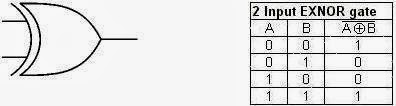
The EX-NOR gate is the contraction of NOR-Exclusive-OR gate.An Ex-Nor gate has two or more inputs and has only one output. The logic operation of the EX-NOR gate is the output is HIGH only when the even number of its inputs  or inputs having all zeros.

Symbol:                                                 Truth Table:

 
See also:


      >>>  How LOGIC  Gates Works

Generations of Operating systems

Operating systems, like computer hardware, have undergone a series of revolutionary changes called generations. In computer hardware, generations have been marked by major advances in component  from vacuum tubes (first generation), to transistors (second generation), to integrated circuitry (third generation), to large-scale and very large-scale integrated circuitry (forth generation). The successive hardware generations have each been accompanied by dramatic reductions in costs, size, heat emission, and energy consumption, and by dramatic increases in speed and storage capacity.
  • The 1940's - First Generations
  • The 1950's - Second Generation
  • The 1960's - Third Generation
  • Fourth Generation (1971-Present) Microprocessors
  • Fifth Generation (Present and Beyond) Artificial Intelligence

The 1940's - First Generations

The earliest electronic digital computers had no operating systems. Machines of the time were so primitive that programs were often entered one bit at time on rows of mechanical switches (plug boards). Programming languages were unknown (not even assembly languages). Operating systems were unheard of .

The 1950's - Second Generation

By the early 1950's, the routine had improved somewhat with the introduction of punch cards. The General Motors Research Laboratories implemented the first operating systems in early 1950's for their IBM 701. The system of the 50's generally ran one job at a time. These were called single-stream batch processing systems because programs and data were submitted in groups or batches.

The 1960's - Third Generation

The systems of the 1960's were also batch processing systems, but they were able to take better advantage of the computer's resources by running several jobs at once. So operating systems designers developed the concept of multiprogramming in which several jobs are in main memory at once; a processor is switched from job to job as needed to keep several jobs advancing while keeping the peripheral devices in use.
For example, on the system with no multiprogramming, when the current job paused to wait for other I/O operation to complete, the CPU simply sat idle until the I/O finished. The solution for this problem that evolved was to partition memory into several pieces, with a different job in each partition. While one job was waiting for I/O to complete, another job could be using the CPU.
Another major feature in third-generation operating system was the technique called spooling (simultaneous peripheral operations on line). In spooling, a high-speed device like a disk interposed between a running program and a low-speed device involved with the program in input/output. Instead of writing directly to a printer, for example, outputs are written to the disk. Programs can run to completion faster, and other programs can be initiated sooner when the printer becomes available, the outputs may be printed.
Note that spooling technique is much like thread being spun to a spool so that it may be later be unwound as needed.
Another feature present in this generation was time-sharing technique, a variant of multiprogramming technique, in which each user has an on-line (i.e., directly connected) terminal. Because the user is present and interacting with the computer, the computer system must respond quickly to user requests, otherwise user productivity could suffer. Time-sharing systems were developed to multiprogramming large number of simultaneous interactive users.

Fourth Generation

With the development of LSI (Large Scale Integration) circuits, chips, operating system entered in the system entered in the personal computer and the workstation age. Microprocessor technology evolved to the point that it become possible to build desktop computers as powerful as the mainframes of the 1970s. Two operating systems have dominated the personal computer scene: MS-DOS, written by Microsoft, Inc. for the IBM PC and other machines using the Intel 8088 CPU and its successors, and UNIX, which is dominant on the large personal computers using the Motorola 6899 CPU family.